
Most Freight Problems Are Communication Problems
The machine is sitting in an auction yard in Ohio. The removal deadline is Thursday. You called your broker Monday morning and it’s now Tuesday afternoon. No quote. No update. Just a voicemail that went to a generic inbox.
That is not a carrier problem. That is a communication problem. And in freight, communication problems turn into missed deadlines, storage fees, damaged equipment, and relationships that don’t get a second chance.
Good freight broker communication is not a soft skill or a nice-to-have. It is the operational backbone of every shipment that goes right. This guide breaks down what it actually looks like, what to expect from a broker who does it well, and what the warning signs are when they don’t.
Why Freight Broker Communication Makes or Breaks Your Shipment
When you hand a machine or a load over to a freight broker, you are trusting them to coordinate between you, the carrier, the rigging crew, the pickup location, and the delivery site. That is four or five different parties who all need accurate information at the right time.
When that information flows correctly, the truck shows up when the rigger is ready. The delivery site has a forklift staged. The Bill of Lading is accurate. The machine arrives on time and in the same condition it left.
When communication breaks down anywhere in that chain, the dominos fall fast. A carrier who was not told about a low overhead clearance at delivery arrives and cannot unload. A rigging crew that was not given the truck’s arrival window misses the pickup window. A BOL with the wrong weight gets flagged at a weigh station.
None of those failures are random. They are all traceable back to a communication gap.

What Good Freight Broker Communication Looks Like: 6 Things to Expect
1. A Real Person, Not a Ticket Number
The first sign of a freight broker who communicates well is that you reach the same person every time. Not a call center. Not a rotating support queue. One agent who knows your shipment, knows your machine, and knows where it is without having to look it up.
At Abound Transport Group, every shipment has one dedicated agent from the quote to the delivery confirmation. When you call with a question about your CNC machine’s ETA, the person who picks up already knows the load, the carrier, and the current status. That is not a luxury. It is the baseline for how freight communication should work.
2. Proactive Updates, Not Just Reactive Ones
A good freight broker does not wait for you to call and ask where your shipment is. They reach out when something changes, when a milestone is hit, and when there is anything you need to know before it becomes a problem.
What proactive communication looks like in practice:
- Pickup confirmation sent the same day the carrier is dispatched
- Notification when the truck arrives at the pickup location
- Update when the machine is loaded and the truck is rolling
- ETA update when the delivery window is confirmed
- Immediate contact if there is a delay, a weather hold, or any change to the timeline
You should never have to hunt for an update on a load worth six figures. If you are chasing your broker more than they are reaching out to you, that is a problem.
3. Clarity Before the Truck Is Dispatched
The time to clarify every detail about a shipment is before dispatch, not after the truck is already rolling. A freight broker who communicates well asks the right questions upfront:
- Is the pickup location accessible for a semi? What are the overhead clearances?
- Is there a rigging crew arranged, and what is their loading window?
- Is there a removal deadline we need to build around?
- What are the delivery site’s receiving hours?
- Does the machine have any access restrictions, special securement requirements, or components that need to be removed before loading?
Every one of those questions, if left unasked, becomes a potential problem at pickup or delivery. A broker who asks them upfront is not being overly cautious. They are doing their job.
4. Accurate Documentation From the Start
Communication is not just verbal. It lives in the paperwork. A Bill of Lading with the wrong weight, incorrect machine description, or missing pre-existing damage notes is a liability that can cost you a damage claim.
Good freight broker communication means:
- The BOL is accurate before the truck arrives, not corrected after the fact
- Pre-existing damage on the machine is documented before the carrier takes possession
- Insurance certificates are issued before pickup, not requested after delivery
- Permits for oversize loads are confirmed before dispatch, not discovered to be missing at a weigh station
Ask your broker to send you the BOL for review before pickup. If they push back on that, it tells you something about how they operate.
5. Honest Updates When Things Go Wrong
Delays happen. Weather holds happen. Carriers have mechanical issues. A broker who communicates well does not hide these things or go quiet when the news is not good. They call you first, explain what happened, and tell you what they are doing to fix it.
The brokers who damage relationships are not the ones whose shipments have problems. Every shipment can have a problem. The ones who damage relationships are the ones who find out about a problem and wait to see if it resolves itself before telling the customer.
When a load is delayed, you should hear about it from your broker before you start wondering where your truck is.
6. A Tracking Link That Actually Works
Real-time GPS tracking is standard in 2026. If your freight broker cannot tell you where your shipment is within 15 minutes of accuracy at any point during transit, they are operating on outdated infrastructure.
At Abound Transport Group, every shipment is tracked through the ATGFr8 portal with live GPS updates throughout transit. You get a tracking link at dispatch and can check your load’s location at any time. When you have a $180,000 CNC machine on a Conestoga step deck crossing three states, you should not have to call anyone to find out where it is.
What Bad Freight Communication Costs You
It is worth being direct about the financial impact of poor freight communication, because it is real and it is specific:
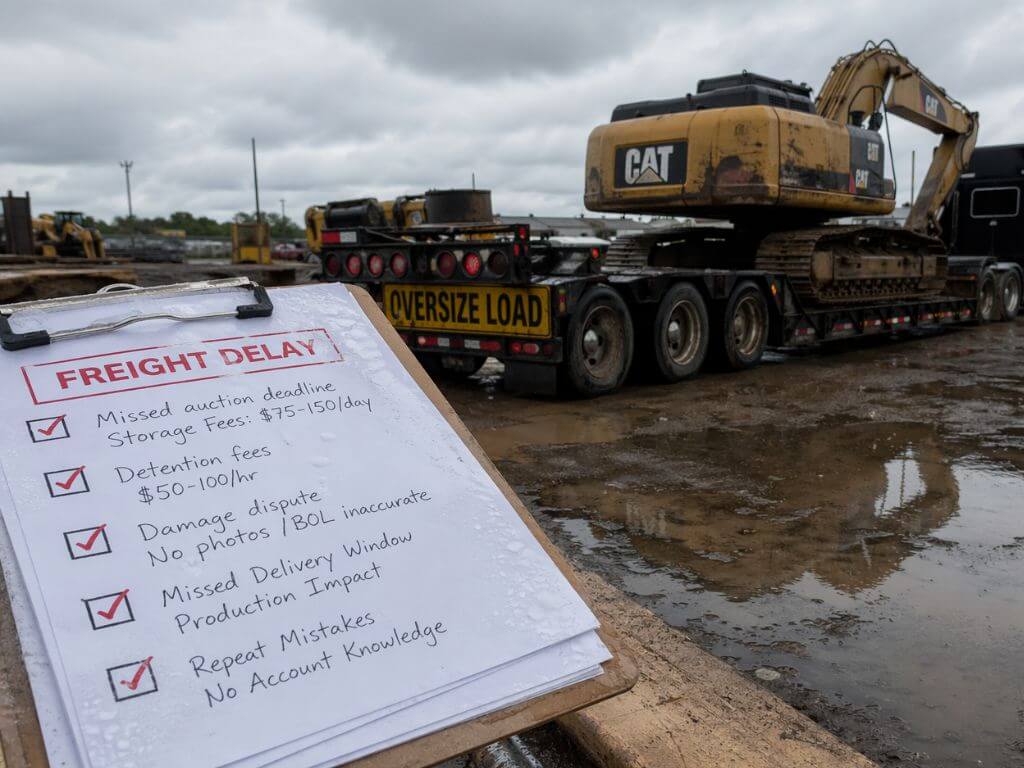
Missed auction removal deadlines from a broker who did not understand the urgency or failed to communicate it to the carrier. Storage fees at major auction yards start accruing the day after the deadline. At $75 to $150 per day, a week of missed communication costs $525 to $1,050 before you even get the machine.
Detention fees from a carrier who arrived at a pickup location before the rigging crew was ready, because the broker did not coordinate the timing. Detention typically runs $50 to $100 per hour after the free time window.
Damage disputes that are difficult to resolve because the BOL was not accurate and origin photos were not taken. Without documentation, a damage claim becomes a he-said she-said between you and the carrier’s legal team.
Missed delivery windows at a manufacturing facility where a forklift crew was staged and waiting, and now has to be rescheduled. In a production environment, that idle time has a real cost.
Repeat logistics mistakes because there is no one at the brokerage who knows your account, your machines, or your facility requirements. Every shipment starts from zero.

How to Evaluate a Freight Broker’s Communication Before You Book
Before you hand a machine to a broker, here are the questions worth asking:
Will I have one dedicated agent for my shipment? If the answer is “it depends on availability” or “our team handles it,” that is a call center model. Ask for a named contact.
How do you provide tracking? If they cannot describe a specific tracking system or portal, ask what they do when a customer wants to know where their load is.
How do you handle delays or problems? Listen for whether they describe a proactive process or a reactive one.
Can I see a sample BOL before we start? A broker who is comfortable with this question runs a clean operation. One who deflects it may not.
Do you coordinate with rigging crews at pickup? For machinery moves, this is the most common coordination failure point. A broker who handles this without being asked is worth knowing.
How Abound Transport Group Handles Communication
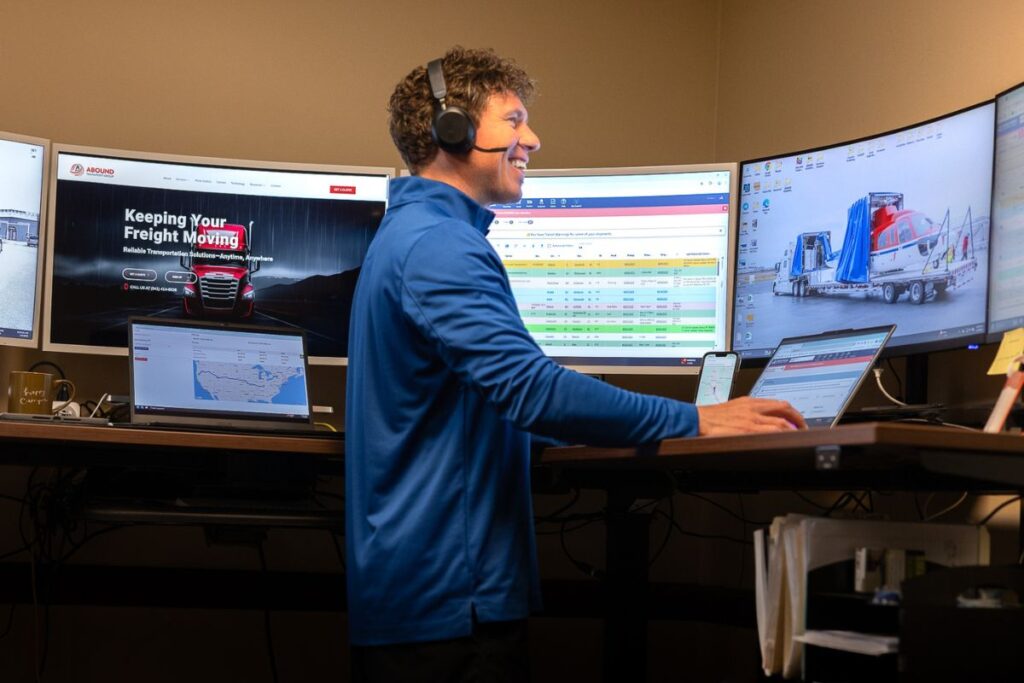
One agent. One point of contact. From the moment you send us your machine specs to the moment we send you the signed delivery receipt.
We quote fast because we know open-deck machinery freight. We dispatch vetted carriers from Armstrong’s 85,000+ network. We coordinate directly with rigging crews at pickup. We send you the BOL before the truck arrives. We track your load in real time through ATGFr8. And if something changes, you hear from us first.
That is what freight broker communication should look like. It is what we do on every shipment.
Request a freight quote and see the difference.
(800) 957-2558 | Monday to Friday, 5:30 AM to 5:00 PM PST
Frequently Asked Questions
You should have one dedicated agent, receive proactive updates at every shipment milestone, get a tracking link at dispatch, and hear from your broker immediately if anything changes. You should never have to chase your broker for a status update on a load in transit.
A freight broker coordinates between the shipper and the carrier throughout the shipment. This includes dispatching the carrier with complete load details, confirming pickup timing with the carrier and rigging crew, monitoring transit progress, and relaying any changes to both parties in real time.
Real-time freight tracking uses GPS technology to show the location of your shipment at any point during transit. For high-value machinery and equipment, it means you always know where your load is and can plan delivery-side operations around an accurate ETA. Abound Transport Group provides live tracking through the ATGFr8 portal on every shipment.
A Bill of Lading is the legal document that records the freight's condition at pickup and transfers responsibility to the carrier. Good communication around the BOL means it is accurate before the truck arrives, reviewed by the shipper before signing, and includes any pre-existing damage. A BOL with errors or omissions can create serious problems if a damage claim arises.
A good freight broker contacts the shipper immediately when a delay occurs, explains the cause, and outlines what is being done to resolve it. They do not wait to see if the problem resolves on its own. Proactive delay communication is one of the clearest indicators of how a broker will handle your account long term.
When you have one agent handling your shipment, they know the full context: your machine's specs, your deadline, your facility's access requirements, and the carrier's status. When you reach a call center or a rotating support team, you restart that context every time you call. For time-sensitive machinery moves with removal deadlines, that context loss costs real money.