A good fit
One to six standard pallets or crates, usually about 3,000 lb or less per pallet, stacked no higher than about 84 inches, headed from or to Southern Oregon and across North America.

Southern Oregon LTL
Move pallets, crates or drums on a shared trailer from Medford, Grants Pass and the Rogue Valley up Interstate 5 to Portland or across North America. The Southern Oregon desk compares national and regional LTL carriers through Armstrong Transport Group and stays with the shipment through delivery.
Abound Transport Group is an authorized agency of Armstrong Transport Group. We arrange LTL freight. We are not a carrier and we do not run a private fleet.

Available any hour
Control your booking, tracking, payments and documents all in one place.
Already have access? Sign in
Armstrong LTL
This short video shows how Armstrong LTL service compares carriers and keeps one team on your shipment. Abound is powered by that same platform, with a coordinator in Southern Oregon on the file.

The basics
Less than truckload shipping is for freight that does not need a full trailer. Your pallets share space with other shippers. You pay for the space and weight you use, and the assigned carrier moves the freight through its terminal network to the delivery address.
One to six standard pallets or crates, usually about 3,000 lb or less per pallet, stacked no higher than about 84 inches, headed from or to Southern Oregon and across North America.
Heavier pieces, pallets over about 8 feet long, or more than about six pallets often price better as a partial or full truckload. Tell us the details and we will compare both.

Southern Oregon desk
Share pickup and delivery ZIPs, pallet count, weight and dimensions. A coordinator compares carrier options through Armstrong and replies in writing.
The path
An LTL carrier picks up your freight, brings it to a terminal, sorts it onto a shared linehaul trailer, and delivers it from the destination terminal. Abound books the move and keeps you updated at each step.
A city driver collects the freight at your dock, warehouse or job site, including a liftgate when you asked for one.
The freight is scanned, sorted and loaded with other shipments headed in the same direction.
A longer haul moves the trailer between terminals. Some lanes run direct. Others transfer at a breakbulk terminal.
The destination terminal sends a city driver to the consignee, with appointment or inside service when those extras were booked.
Classification
Most LTL pricing uses freight class. For many commodities, class comes from density: pounds per cubic foot. Cubic feet is length times width times height in inches, divided by 1,728. Density is the shipment weight divided by those cubic feet.
Some items have a fixed class in the National Motor Freight Classification. Handling, stowability and liability can also change class. If you are not sure, leave class as not sure on the quote form and the desk will review it before a quote goes out.
Preparation
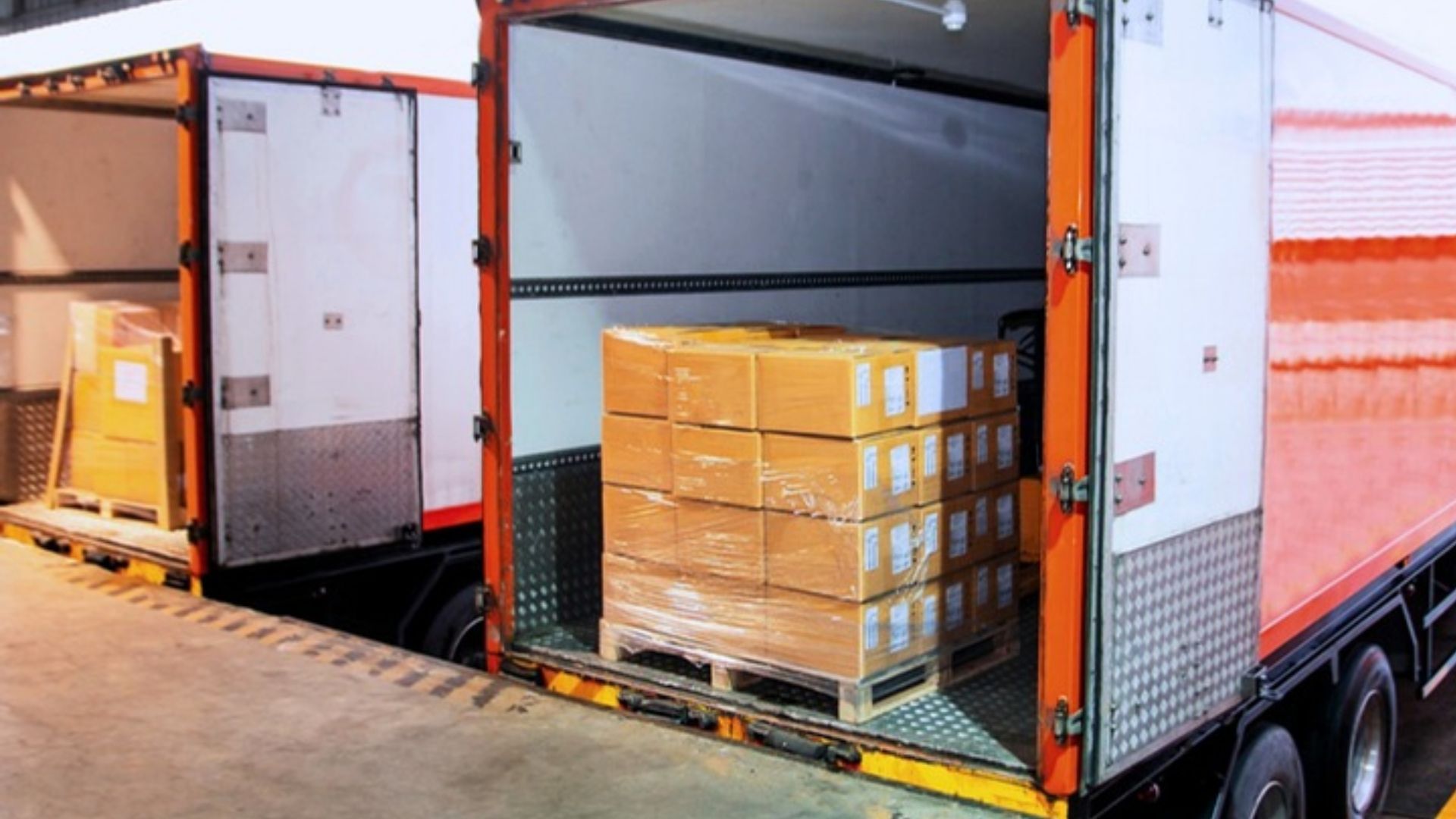
A square, well-wrapped pallet travels cleaner through terminals. Use a sturdy 48 by 40 inch pallet when you can, keep the load inside the pallet footprint, stretch-wrap it to the deck, and add corner boards on tall stacks.
Use a sturdy pallet, keep cartons inside the edges, and avoid overhang.
Stretch wrap the load to the pallet itself, with corner boards on tall stacks.
Show the shipper, consignee and piece count so the terminal team can match each pallet.
Quote the real weight and outside dimensions so the carrier does not reclass or reweigh it.
Extra services
Accessorials are extra services beyond a dock-to-dock pickup and delivery. Select them on the quote form so the assigned carrier plans the right truck and the quote includes the work.
Needed when there is no dock or forklift. The driver lowers the pallet to the ground with a liftgate.
Homes, farms and many job sites are not commercial docks. Mark residential so the carrier plans extra time.
Some receivers require a scheduled window. We request the appointment and pass the time back to you.
The driver brings freight past the threshold when the site and the carrier both allow that service.
Choose the mode
LTL works when you have a few pallets and can share a trailer. Volume or partial truckload starts to win when the freight takes more of the trailer, needs a tighter transit, or should not transfer through extra terminals.
Smaller pallet counts, standard sizes, and lanes where a regional or national LTL carrier already runs strong daily service. Transit can include terminal handling, which is normal for this mode.
More than about six pallets, freight that is long or heavy, or a receiver that wants the freight to stay on one trailer from pickup to delivery. We will quote both modes when the details support it.
Before you request a quote
Six details make the quote hold up when the freight moves. The quote page walks you through each one in three short steps.
Pickup and delivery ZIP or postal codes, plus whether each stop is a business or a home.
How many pallets, crates or drums, and the type of each.
Total weight from a scale, pallets included.
Length, width and height in whole inches, measured after wrapping.
A short description of the freight, plus class or NMFC item if you know it.
Liftgate, residential, appointment or inside delivery at either end.
After you send it
Your request goes to a person, not a queue. Here is the path from the quote page to a booked pickup.
Your request lands with the Southern Oregon desk by email, with every detail you entered.
A coordinator reviews class, density, dimensions and extra services so the quote matches the freight.
National and regional LTL carriers are compared through Armstrong Transport Group's platform.
You get options in writing. Pick one, and we book the pickup and stay with it through delivery.
One coordinator
You work with a person who knows the shipment, not a rotating call center. If a pickup slips or a receiver has a question, you have a direct contact.
When freight is delayed or damaged
Your coordinator tracks the pickup, the terminals and the delivery, then helps with claims paperwork if freight is delayed, short or damaged. You are not left to chase the carrier alone.
Take clear photos at pickup and delivery, keep the bill of lading, and tell us as soon as you see a problem.

Visibility
Your quote and tracking run through Armstrong Transport Group's platform. One request can reach national and regional LTL carriers. You can also sign up for ATGFr8 to compare options, track shipments and manage documents any time.
Read how Armstrong technology supports quoting, tracking and documents across North America.
Need the dimensions of a dry van or another trailer type before you plan the pallet pattern? Open the trailer guide.
North America
Yes. Many LTL lanes continue across the border when the paperwork is ready. Abound coordinates the U.S. pickup or delivery from Southern Oregon and works with Armstrong's cross-border partners for the international move.
PARS, PAPS and eManifest details live on our Canada freight page, along with how we handle inbound and outbound transits.
Pedimento, Carta Porte and the right crossing all affect transit. Start on the Mexico freight page before you tender the shipment.
Powered by Armstrong Transport
LTL service from carriers such as these, accessed through Armstrong Transport Group's LTL platform.








Carrier names and logos are trademarks of their respective owners and are shown for identification only; no endorsement implied. Carrier availability varies by lane.
A shipper's guide from Abound Transport Group, powered by Armstrong Transport
Six carriers run direct networks across the lower 48.
Regional carriers are often strongest inside their core states.
Your origin and destination decide which carrier fits best.
Armstrong's LTL platform compares national and regional carriers.
Direct service areaPartial direct coveragePartner or interline service
National network
Direct service to all 48 contiguous states from 213 terminals. Next-day up to 600 miles, second day up to 1,200 miles.
saia.com
National network
Nationwide direct coverage, with offshore, Canada and Mexico service. One of the broadest LTL footprints.
estes-express.com
National network
260 service centers across the continental United States. Deep national network.
odfl.com
National network
LTL coverage reaching more than 99% of U.S. ZIP codes. Plus Canada and Mexico service.
xpo.com
National network
Direct LTL service to all 50 states, including Alaska and Hawaii. 140+ service centers.
rlcarriers.com
National network
About 240 service centers across the U.S., Canada and Puerto Rico. ArcBest company.
arcb.com
Regional network
Mid-Atlantic and Midwest: DE, DC, IN, MD, MI, NJ, OH, PA, VA, WV. Plus parts of KY, NY and NC. 25 terminals.
pittohio.com
Regional network
Southeast and South Central core, from the Gulf Coast to the Carolinas. Coast to coast through partners.
aaacooper.com
Regional network
Service centers in 13 Southeast and Southwest states plus Puerto Rico. Next-day specialist.
sefl.com
Regional network
Midwest and Great Lakes: IL, IN, IA, KS, KY, MI, MN, MO, NE, OH, PA, TN, WI. Regional direct points.
daytonfreight.com
Start with where the freight picks up and where it delivers. A carrier with direct service at both ends usually means fewer handoffs. Then look at transit days, extra services such as liftgate or residential delivery, and freight class. Send us the lane and we will compare the options for you.
Coverage reflects each carrier's own published service-area information as of October 2026. Service areas change, so we confirm coverage on every quote. Carrier names are trademarks of their owners and are shown for reference only.
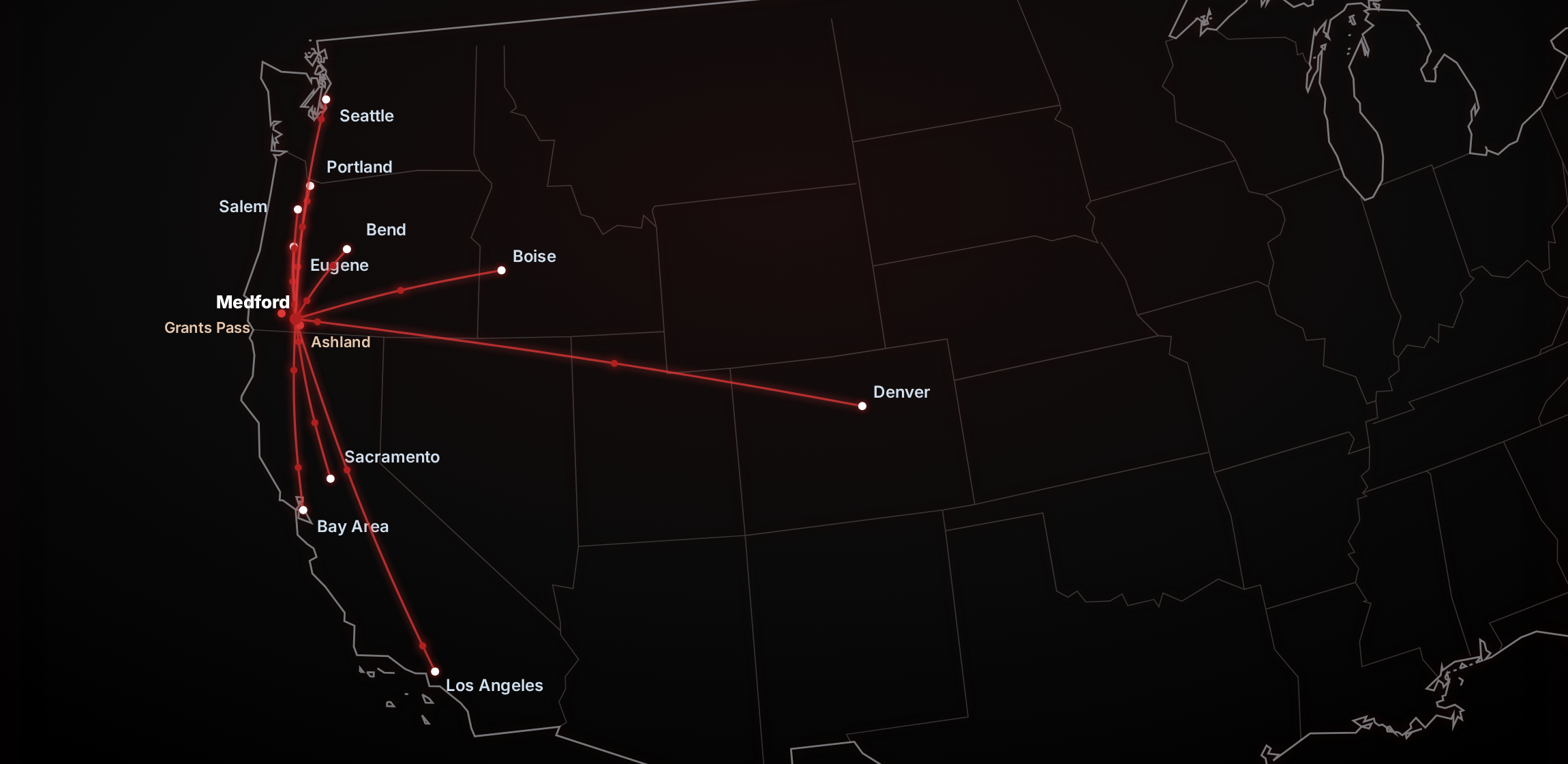
Outbound LTL from Medford and Southern Oregon to major markets in the USA, Canada and Mexico
Lanes shown are common examples, not a list of every lane. Transit times vary by carrier and lane.
Oregon LTL from Medford to Seattle, Portland, Boise, Sacramento, the Bay Area, Los Angeles, Phoenix, Salt Lake City and Denver.
Longer lanes from Southern Oregon into Dallas, Houston, Chicago and Ohio, quoted the same way as closer regional moves.
Coast-to-coast LTL from the Rogue Valley to Atlanta, Charlotte, Miami and the New York and New Jersey metro.
Cross-border LTL toward Vancouver, Calgary, Toronto and Montreal. We work with your customs broker and the assigned carrier on the border plan.
Palletized freight toward Tijuana, Monterrey, Guadalajara and Mexico City, coordinated with your broker and the carrier.
Freight from suppliers across the USA, Canada and Mexico into Medford, Grants Pass, Ashland and nearby towns. Tell us delivery details early: dock, liftgate or appointment.
Accurate weight and dimensions keep the freight class right and help avoid reweigh and reclass charges.
No dock, residential, limited access or appointment? Put it on the quote so the assigned carrier plans the right truck.
Lanes shown are common examples, not every lane we can quote.
Questions
It is shipping a few pallets or crates from Medford and Southern Oregon, or inbound to those cities, on a shared trailer. You pay for the space and weight you use, and the assigned carrier moves the freight through its terminals to the delivery address. Abound arranges the move and stays with it.
No. Abound is a Southern Oregon transport company and an authorized agency of Armstrong Transport Group. We match your shipment to an LTL carrier, book it, and stay with it until it delivers. We do not run our own trucks, and we never claim a private fleet.
Pickup and delivery ZIP or postal codes, the location type at each end, the number of pallets or crates, length, width and height in whole inches, the real weight, what the freight is, and any extra services such as a liftgate. The quote form walks you through each item.
For most freight it comes from density. Cubic feet is length times width times height in inches, divided by 1,728. Density is weight divided by cubic feet. Some commodities have a fixed class tied to an NMFC item, so we check that before quoting. Leave class as not sure if you do not know it.
If there is no dock or forklift at pickup or delivery, yes. Homes, small shops, storage units and many job sites need a liftgate so the pallet can be lowered to the ground. Select liftgate on the form so the quote includes it and the right truck is planned.
Yes, when the paperwork is right and the assigned carrier accepts that hazard class. We need the UN number, proper shipping name, hazard class, packing group, and a 24 hour emergency contact. Mark hazmat on the form and we will follow up before quoting.
We suggest it. Carrier liability on LTL is limited by class and weight, which is often far below the real value of the freight. When you share a value, we can ask about extra All Risk coverage that may be available for qualifying loads, subject to terms and approval.
When freight is long, tall, heavy, delicate, or fills a large part of the trailer. Standard LTL works best for about one to six sturdy pallets. See partial truckload or heavy haul and oversize, or send the details and we will compare the modes that fit.
Yes. We arrange LTL to and from Canada and to and from Mexico. Share both postal codes, your customs broker, and the commercial invoice details so the border plan is in place before pickup. See our Canada freight and Mexico freight pages for the document lists.
Measure length, width and height in inches at the widest points after the pallet is wrapped, overhang included. Weigh it with the pallet, not as a guess. Those numbers set density and class, and they are the simplest way to keep the invoice close to the quote.
Schools, churches, construction sites, farms, storage units, airports, fairgrounds and some gated sites often count as limited access. Homes are usually residential rather than a standard business dock. Pick the matching extra on the form so it is on the bill of lading.
Plan on about 3,000 lb or less per standard 48 by 40 inch pallet. Most LTL carriers handle that without special approval. Heavier single pieces often need approval or a move on partial truckload instead. Exact limits vary by carrier, and we confirm them on the quote.
Yes. The quote form can be sent any hour. You can also sign up for an ATGFr8 customer login to compare national and regional LTL carrier options in one place. A coordinator on the Southern Oregon desk reviews the request and replies with options, not a guessed price.
Yes. Medford to Portland is a common Oregon LTL lane, running north and south on Interstate 5 with stops in Grants Pass, Roseburg, Eugene and Salem. We compare national and regional LTL carriers that serve the corridor, then book the option that fits your pickup date, freight and delivery needs.
Checked November 2026.