
One Wrong Move and a $200,000 Machine Becomes a Repair Bill A CNC machine is not a pallet of boxes. It is a precision instrument. The spindle in a vertical machining center is calibrated to tolerances measured in thousandths of an inch. The ball screws in a horizontal lathe are set to specifications that took a factory floor technician hours to dial in. When that machine gets loaded onto the wrong trailer, secured by a driver who has never moved industrial equipment, or bounced across 1,400 miles on a flatbed without proper blocking, those tolerances do not survive the trip.
We have seen it happen. A shop buys a Mazak HCN-5000 at auction, books a cut-rate carrier, and the machine arrives with a cracked casting and a spindle that wobbles. The machine cost $180,000. The repair estimate comes back at $40,000. And the shop is down for six weeks waiting on parts.
Shipping a CNC machine correctly is not complicated. But it does require knowing what you are doing at every step. This guide walks you through the entire process, from how to prepare the machine before it leaves the seller’s floor to what to inspect at delivery, so your equipment arrives exactly the way it left.
Step 1: Prepare the Machine Before It Leaves the Floor
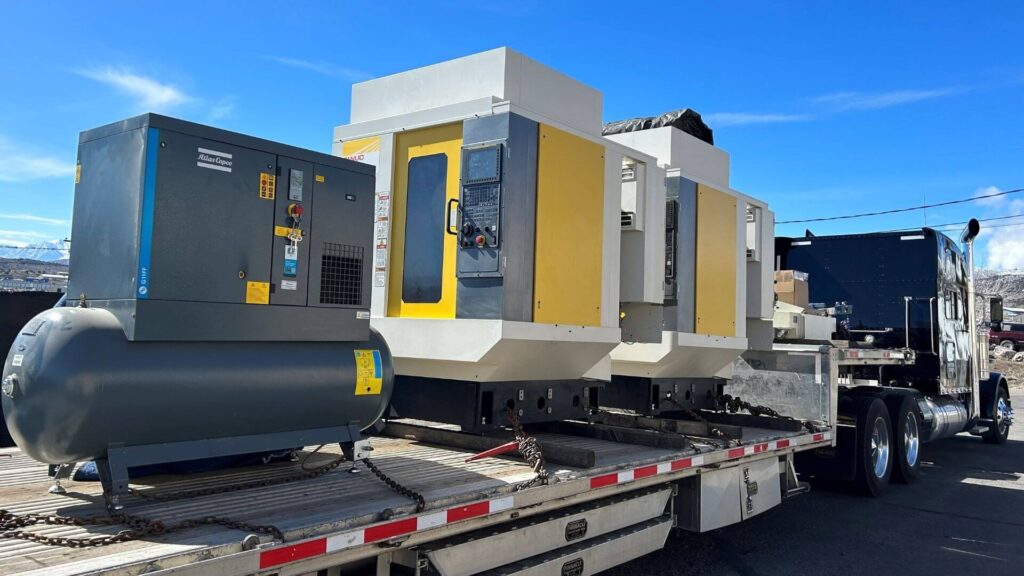
Most CNC transport damage does not happen on the highway. It happens before the truck even moves, because the machine was not properly prepared for transit. Here is what needs to happen before loading:
Drain all fluids. Coolant tanks, hydraulic reservoirs, and spindle oil systems need to be drained or at minimum reduced to the lowest safe level. Fluid shifts during transport and creates instability. Coolant that has not been drained can also freeze in winter transit, expanding inside the system and cracking lines or reservoirs.
Lock the axes. Most CNC machines have transport locks or locking bolts for the X, Y, and Z axes. Use them. If your machine does not have factory transport locks, the axes need to be secured with blocking so they cannot move during transit. Unsecured axis movement is one of the most common causes of transit damage on vertical machining centers and lathes.
Remove or secure the tooling. Tool holders, probes, and anything loaded in the spindle or turret need to come out before transport. These components are precision-ground and are not designed to absorb vibration or lateral movement. Remove them and pack them separately.
Disconnect and protect the electrical. Pendant arms, control panels, and any external cabling should be secured close to the machine body. Pendant arms are frequently damaged when they swing freely on a moving trailer. Tape or strap them down. If the pendant is removable, remove it and pad it separately.
Document the condition with photos. Before the machine leaves the seller’s floor, walk around it with your phone and photograph every side, the control panel, any existing scratches or dings, and the loading process. This documentation is your proof of condition at origin. If there is a dispute at delivery, you need these photos.
Measure and confirm the specs. Get the actual loaded dimensions before the truck shows up. Length, width, height, and weight. Many machine manufacturers publish specs, but those numbers are for the machine as installed, not as shipped. Coolant tanks, chip conveyors, and ancillary equipment can add significant weight and change the height profile. Accurate dimensions determine everything that comes next.
Step 2: Choose the Right Trailer
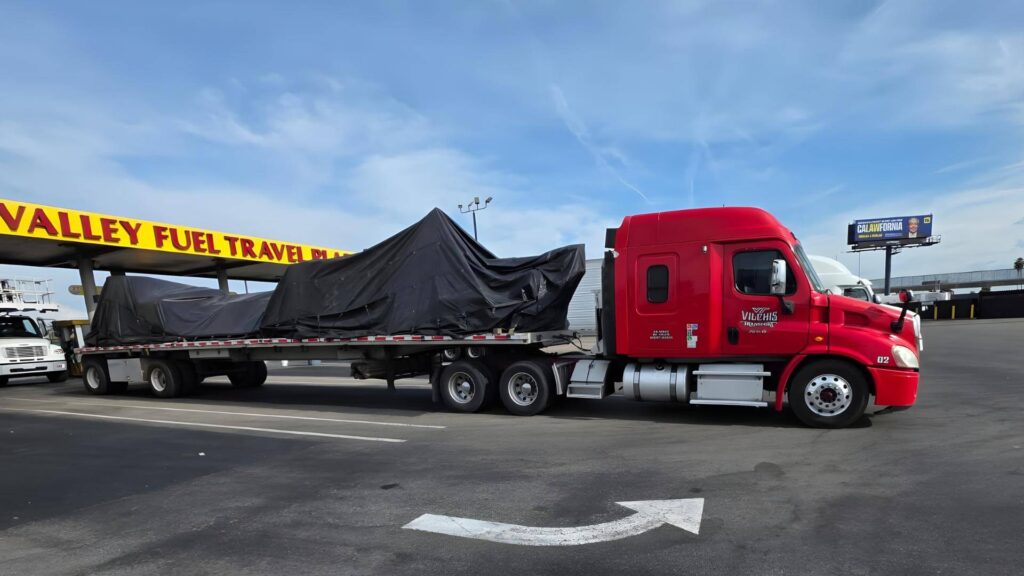
This is where most shippers go wrong. They default to whatever trailer is cheapest or most available without considering whether it is actually the right tool for their machine’s specific dimensions and sensitivity. Here is how to think through it:
Flatbed (48 or 53 ft)
Deck height: approximately 58 inches off the ground. Maximum legal load height: 13.5 feet total (deck plus cargo). Payload capacity up to 48,000 lbs.
Best for: Compact CNC mills, lathes under 90 inches tall, horizontal machining centers with a low profile, and machines that can be fully tarped without surface contact concerns.
The flatbed is the workhorse of CNC transport. It works well for a broad range of machines. The limitation is height. If your machine with the coolant tank attached stands 90 inches tall, you are sitting at 148 inches total on a standard flatbed, which is over the legal limit in most states.
Step Deck (48 or 53 ft)
Lower deck height: approximately 42 inches. Maximum legal load height on lower deck: around 10 feet. Payload capacity up to 48,000 lbs.
Best for: Taller vertical machining centers, large Haas VF-series machines, 5-axis machining centers, and any CNC equipment that exceeds flatbed height limits but does not require the extra clearance of a double drop.
The step deck is the most commonly used trailer for mid-size to large CNC machines. The lower rear deck gets taller machines under the legal height threshold, and the longer deck accommodates machines with chip conveyors or extended footprints. Learn more about step deck specifications here.
Double Drop / RGN (Removable Gooseneck)
Well height: approximately 18 to 24 inches. Maximum legal load height in the well: approximately 11 feet 6 inches. Multi-axle configurations for heavy loads.
Best for: Extra-tall vertical turning lathes, large boring mills, heavy injection molding machines, and any machine that cannot legally or physically ride on a step deck. The RGN allows the machine to be driven or rolled directly onto the trailer through the removable front gooseneck, which is critical for machines that cannot be craned.
See RGN and lowboy specs here.
Conestoga Flatbed or Step Deck
Same deck heights as standard flatbed and step deck, but with a rolling tarp system that fully encloses the load without any tarp-to-cargo contact.
Best for: Sensitive CNC equipment with exposed control panels, finished surfaces, or electronics that should not be touched by a canvas tarp. Conestoga is the gold standard for machines like Haas and Mazak that have painted enclosures, glass windows, or operator panels on the exterior. It eliminates tarp rash entirely and keeps the machine sealed from road debris and weather for the full transit.
Read our full breakdown of tarp vs. Conestoga for CNC transport here.
Quick Reference:
| Machine Type | Recommended Trailer |
|---|---|
| Compact CNC mill or lathe under 90″ tall | Flatbed or Conestoga Flatbed |
| Haas VF-series, Mazak Integrex, larger VMCs | Step Deck or Conestoga Step Deck |
| Large boring mills, VTLs, heavy machining centers | Double Drop / RGN |
| Extra-heavy machines over 48,000 lbs | Multi-axle RGN or heavy haul lowboy |
| Any machine with exposed panels or glass | Conestoga (flatbed or step deck) |
Step 3: Crating and Securement
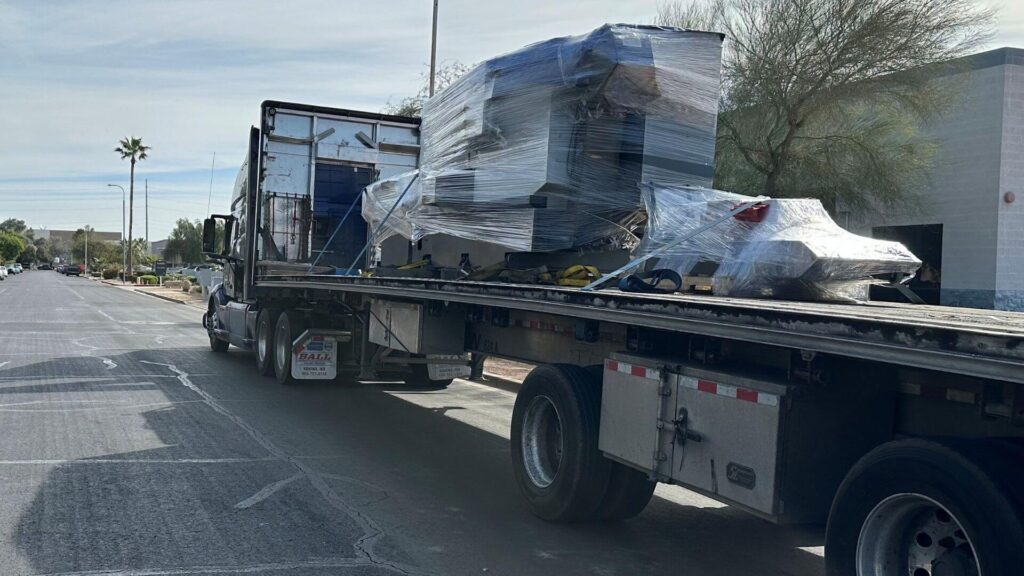
A machine that is not properly secured on the trailer is a machine that will shift. Even a slight shift during braking or cornering can cause damage to precision ground surfaces, knock a leveling pad out of position, or crack a casting.
Custom skids and blocking. Most shop-ready CNC machines are not designed to sit directly on a flatbed deck. They need a skid built to distribute the load correctly across the machine’s base, prevent point loading on the deck, and give the securement straps a stable anchor. A proper skid is bolted to the machine’s base mounting points, not just slid underneath it.
Edge protection. Anywhere a strap contacts the machine, there needs to be corner protection. Steel edges on CNC enclosures will cut through a webbed strap over the course of a long haul, and strap pressure directly on painted or finished surfaces causes damage. Foam edge protectors, rubber blocks, or pipe lagging protect both the machine and the straps.
Tie-down count and placement. Under FMCSA regulations, a load requires a minimum of one tie-down per 10 feet of length and a minimum of two tie-downs for any load over 1,100 lbs. CNC machines almost always require more than the legal minimum. A proper securement plan uses straps at each anchor point on the machine base, with chains or binders for particularly heavy or dense equipment. The goal is zero movement in all directions, not just front to back.
Blocking and bracing. On heavier machines, timber blocking between the machine base and the trailer deck prevents any rocking or shifting that straps alone cannot stop. This is standard practice for injection molding machines and large horizontal machining centers.
Step 3: Crating and Securement
A machine that is not properly secured on the trailer is a machine that will shift. Even a slight shift during braking or cornering can cause damage to precision ground surfaces, knock a leveling pad out of position, or crack a casting.
Custom skids and blocking. Most shop-ready CNC machines are not designed to sit directly on a flatbed deck. They need a skid built to distribute the load correctly across the machine’s base, prevent point loading on the deck, and give the securement straps a stable anchor. A proper skid is bolted to the machine’s base mounting points, not just slid underneath it.
Edge protection. Anywhere a strap contacts the machine, there needs to be corner protection. Steel edges on CNC enclosures will cut through a webbed strap over the course of a long haul, and strap pressure directly on painted or finished surfaces causes damage. Foam edge protectors, rubber blocks, or pipe lagging protect both the machine and the straps.
Tie-down count and placement. Under FMCSA regulations, a load requires a minimum of one tie-down per 10 feet of length and a minimum of two tie-downs for any load over 1,100 lbs. CNC machines almost always require more than the legal minimum. A proper securement plan uses straps at each anchor point on the machine base, with chains or binders for particularly heavy or dense equipment. The goal is zero movement in all directions, not just front to back.
Blocking and bracing. On heavier machines, timber blocking between the machine base and the trailer deck prevents any rocking or shifting that straps alone cannot stop. This is standard practice for injection molding machines and large horizontal machining centers.
Step 4: Permits and Insurance
When do you need an oversize permit?
Any load that exceeds the following thresholds in most states requires an oversize or overweight permit:
- Width: over 8.5 feet
- Height: over 13.5 feet total (truck plus load)
- Length: over 53 feet
- Gross vehicle weight: over 80,000 lbs
CNC machines cross these thresholds more often than most shippers expect. A large horizontal machining center with a pallet changer can easily reach 9 or 10 feet wide. A tall gantry-style machine on a flatbed can push 14 feet. An injection molding press with clamping unit attached can weigh 80,000 lbs by itself before the truck is factored in.
Permits are state-specific. A move crossing eight states requires eight separate permit filings, route surveys in some states, and in some cases pilot car escorts. Attempting to move an oversize CNC load without permits is not just illegal. It is dangerous and will result in fines, forced unloading on the side of the highway, and a carrier that will not touch your freight again.
At Abound Transport Group, permit coordination is part of what we do. We handle the filings, confirm routing, and arrange escorts when required so you do not have to navigate that process yourself.
Insurance: standard liability vs. all-risk cargo coverage
Every licensed carrier is required to carry cargo liability insurance. The legal minimum is $100,000. On a $200,000 CNC machine, that minimum coverage leaves you significantly underexposed.
Standard carrier liability also has exclusions. It typically does not cover damage caused by improper loading, acts of God, or mechanical breakdown of the equipment itself. Disputes over who caused the damage are common, and claims can drag on for months.
All-risk cargo insurance covers the full declared value of your machine regardless of fault. At Abound Transport Group, we offer all-risk cargo coverage up to $2.5 million per shipment, with same-day certificate issuance and claims handling that does not require you to fight a carrier’s legal team.
Learn more about our cargo insurance options here.
For any CNC machine worth more than $50,000, all-risk coverage is not optional. It is common sense.
Step 5: Understand What Drives the Cost
CNC machine shipping quotes vary widely, and if you do not know what drives the price, you cannot evaluate whether a quote is fair or whether something is being cut to hit a low number.
Distance is the most obvious factor. A 500-mile regional move costs significantly less than a coast-to-coast haul. But distance is not the only variable.
Machine dimensions and weight determine trailer type, and trailer type determines cost. A machine that can go on a standard flatbed is cheaper to move than one that needs a step deck. A step deck is cheaper than a double drop RGN. Heavy haul with multiple axles and pilot cars is in its own pricing category.
Conestoga vs. tarp adds a cost premium but provides meaningfully better protection. For most CNC machines, the additional cost of a Conestoga is small relative to the value of the machine.
Permits add cost on oversize moves, typically $100 to $500 per state depending on the state and the load dimensions. Multi-state oversize moves can add $1,000 to $3,000 or more in permit costs alone.
Fuel surcharge fluctuates with diesel prices and is built into every quote. Requesting quotes during high fuel periods will reflect that in the rate.
Seasonal demand affects pricing too. Rates tend to rise in late spring and fall when agricultural freight competes for open-deck capacity. If your timeline is flexible, mid-winter or early spring often yields better rates.
Accessorials like liftgate services, limited access fees, or inside delivery can add to the total if they are needed at the pickup or delivery location.
The best way to get an accurate quote is to provide the actual dimensions and weight of the machine as it will be loaded, the exact pickup and delivery zip codes, the desired pickup window, and any known access restrictions at either end. Vague specs produce inaccurate quotes.
Step 6: What to Do at Delivery
The machine arriving at your facility is not the end of the process. What happens in the first 15 minutes after the truck arrives matters significantly.
Inspect before the driver leaves. Walk the machine before the driver unstraps and before anything is offloaded. Look for visible damage to the enclosure, the control panel, the coolant tank, and any exterior components. Compare what you see to the photos you took at origin. If something looks wrong, note it on the delivery receipt before signing. Do not sign a clean delivery receipt and then try to file a claim later. A signed clean BOL (bill of lading) is the carrier’s best defense against a damage claim.
Check the securement. Before the machine is unloaded, confirm the straps and blocking are intact. If something shifted during transit, you want to know how it was loaded when it arrived.
Coordinate rigging in advance. A CNC machine coming off a flatbed or step deck needs a forklift or crane with the right capacity. Make sure your rigging crew or forklift operator is on-site and ready before the truck arrives. Waiting on rigging after the driver is there costs you detention fees and wastes the driver’s hours of service time.
Do not power it up immediately. Let the machine acclimate to the facility temperature, especially in winter. Thermal shock from moving a machine from an unheated truck into a heated shop can cause condensation inside the electrical cabinet. Give it a few hours before powering up, then check fluid levels, inspect for any mechanical issues, and run a verification cycle before putting it into production.
Abound Transport Group Moves CNC Machines Every Day
We are not a generalist freight broker that occasionally ships a machine. CNC machinery transport is a core part of what we do. We have moved Haas VF-series machines, Mazak Integrex systems, Okuma lathes, DMG MORI 5-axis machining centers, and injection molding presses up to 225 tons. We understand the securement requirements, the trailer selection decisions, the permit process, and the insurance options that protect high-value equipment.
Our team provides direct one-to-one communication from quote to delivery. No call centers. No handoffs. The agent who quotes your load is the agent who sees it through.
We are powered by Armstrong Transport Group’s 85,000+ vetted carrier network, which means we have access to the right trailer for your machine regardless of where you are shipping from or to. Real-time GPS tracking is standard on every shipment through the ATGFr8 portal, with updates every 15 minutes.
Get a custom quote for your CNC machine shipment.
(800) 957-2558 | Monday to Friday, 5:30 AM to 5:00 PM PST